


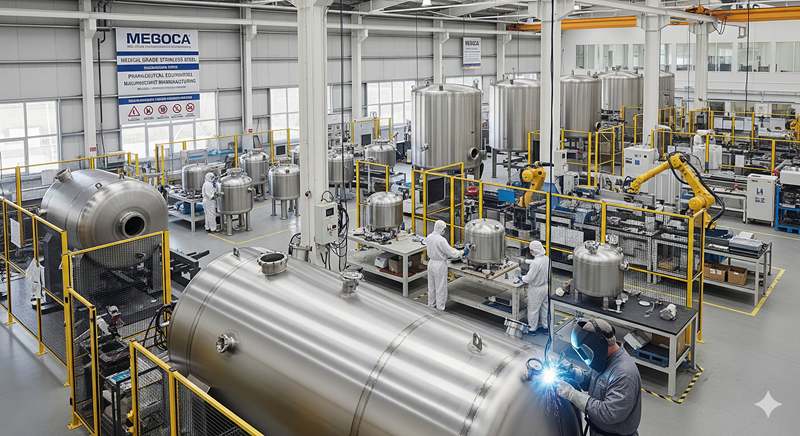
The Medical & Pharmaceutical sector is founded on the noble purpose of improving the quality of human life, treating diseases, and expanding the boundaries of scientific knowledge; therefore, an absolute standard of precision, purity, and reliability prevails over every piece of equipment, component, and process used in this field. Although the success of this sector is often associated with advanced diagnostic devices or revolutionary drug molecules, behind these achievements lie the often unseen but vitally important equipment that makes the processes possible, and the perfectly functioning accessories of this equipment. From ultra-pure medical gases to the cryogenic liquids that protect biological samples from the ravages of time, the storage and use of these essential materials require systems specifically designed for Medical & Pharmaceutical applications. At this point, companies like Cryotanx, which adhere to the highest quality and purity standards in every pressure vessel they produce, stand out as the most reliable solution partners for this sensitive sector; because in this field, a valve, a regulator, or a sensor is not a simple “accessory,” but a assurance mechanism that directly touches human health.
The Foundation of Life Support and Biotechnology: Medical Gas Storage Systems
One of the cornerstones of modern Medical & Pharmaceutical applications is the use of specialty gases and cryogenic liquids. The most critical and widespread application in this field is undoubtedly the medical oxygen supply in hospitals. An uninterrupted, pure, and reliable oxygen source for a hospital’s respiratory support units, operating theaters, and emergency services is, in the truest sense of the word, vital. To meet this need, modern hospitals typically use a central micro-bulk tank system located outside the facility. These tanks, manufactured by Cryotanx, store high-purity medical oxygen in liquid form (LOX) at -183°C. This allows for much more oxygen to be stored safely and at much lower pressures compared to its gaseous form.
However, the system is not just a tank. Specially designed vaporizers are needed to convert the liquid oxygen into a gaseous phase before it reaches the patients. A series of critical accessories and components, such as medical-grade regulators to maintain the correct pressure, specially cleaned safety valves to protect the system from overpressure, and precise level indicators that allow real-time monitoring of the oxygen quantity in the tank, make up the entire system. Since a failure in any part of this system would lead to unacceptable consequences, it is mandatory that all components meet the highest quality and reliability standards. Another revolutionary application in the Medical & Pharmaceutical field is cryopreservation, or storage by freezing. The ultra-low temperature of liquid nitrogen (-196°C) halts all biological activity in cells and tissues, offering the ability to store them for years, even decades, without degradation.
The preservation of sperm and embryos in IVF centers, valuable stem cells in stem cell banks, and cell lines and tissue samples in research laboratories is possible thanks to this technology. These priceless biological materials are stored in portable and high-efficiency cryogenic storage tanks, commonly known as DEWAR tanks. The reliability of these tanks depends on their accessories. Electronic systems that continuously monitor temperature and liquid nitrogen levels and trigger an alarm in case of a critical drop, locking mechanisms that prevent unauthorized access to samples, and insulation systems that maintain the tank’s vacuum integrity are the most important components of these tanks. A DEWAR tank used in this field is not just a container, but a vault holding the hope of a future life or a scientific discovery.
Purity and Control in Drug Manufacturing: Pharmaceutical Applications and Equipment
In pharmaceutical manufacturing, the other wing of the Medical & Pharmaceutical sector, the words “purity,” “repeatability,” and “control” come before all else. Every batch of a drug must be identical to the previous one and must not contain any foreign substances. To achieve these goals, the equipment used in production processes and their associated accessories must meet the strictest standards. One of the important processes in pharmaceutical production is lyophilization, or freeze-drying. In this method, used especially to ensure the stability of sensitive biological drugs like vaccines and antibodies, the product is first frozen to very low temperatures, and then, under high vacuum, the ice is allowed to separate from the structure by sublimating (evaporating directly). The speed and temperature of this freezing process directly affect the final quality of the product, and the cooling capacity required for this process is usually provided by liquid nitrogen.
Therefore, it is critical to have a reliable liquid nitrogen storage system (a micro-bulk tank or DEWAR tank) next to the lyophilization units. Another common application is “inerting.” Many active pharmaceutical ingredients (APIs) can degrade or enter into unwanted side reactions when they come into contact with oxygen. To prevent this, the inside of reactors or mixing vessels is purged with high-purity nitrogen gas to completely remove oxygen before the reaction begins, and a “nitrogen blanket” is formed over the product throughout the process. This nitrogen is also supplied from a cryogenic storage tank, and the purity of the gas is vital for the quality of the final product. All accessories that carry this gas, such as pipes, valves, and regulators, must be made of special materials and cleaned in a way that does not introduce any contaminants into the system.
The most fundamental feature that distinguishes equipment in the Medical & Pharmaceutical sector from other industries is the “validation” requirement. The validation of a piece of equipment is the process of documenting that it performs its intended job correctly, reliably, and repeatably. This process typically consists of three stages: Installation Qualification (IQ), Operational Qualification (OQ), and Performance Qualification (PQ). A company serving this sector, like Cryotanx, not only delivers the equipment but must also provide all the technical documentation, material certifications, and test reports necessary for the customer to successfully complete these validation processes. This is an extremely meticulous process that requires full traceability of every custom-fabricated part and accessory.
Medical & Pharmaceutical
The equipment and systems used in the Medical & Pharmaceutical field are much more than an assembly of individual parts; they are validated and holistic systems in which every component works in perfect harmony. In a hospital’s life support system or a pharmaceutical plant’s production line, the reliability of the system is only as strong as its weakest link. Therefore, all accessories and components, from the main storage tank to the smallest valve, must be selected and integrated with the same philosophy of high quality, purity, and reliability. This is the fundamental responsibility that comes with serving the Medical & Pharmaceutical sector. This holistic approach forms the basis of the solution partnership model for companies like Cryotanx. The company does not just sell a medical oxygen tank to a hospital; it analyzes the hospital’s needs and designs a complete skid-mounted unit that includes the correctly sized tank, vaporizer, regulator panel, and alarm systems.
All these accessories are selected to meet medical standards (such as “cleaned for oxygen service”) and come with full material certification. The system is assembled and tested at the factory and delivered to the site as a ready-to-operate module. This offers the customer not just a product, but also ease of installation, faster commissioning, and most importantly, the assurance of system integrity from a single source. The needs of the Medical & Pharmaceutical sector often go beyond standard products. A research institute may require a DEWAR tank with a special geometry or connection points for a specific experiment. A biotechnology firm might request a special mixing and cooling vessel for a new production process. In such cases, the ability to design and manufacture custom-fabricated parts comes into play.
This demonstrates the company’s engineering depth and its ability to find solutions to the customer’s unique problems. These custom parts are also subjected to the exact same quality control, testing, and validation documentation processes as standard products. In conclusion, providing technology, equipment, and accessories to the Medical & Pharmaceutical sector requires a deep sense of responsibility. Every system produced here, directly or indirectly, touches human health. The purity of the oxygen that gives breath to a patient, the safe storage of stem cells holding the hope for a future treatment, or the quality of a life-saving drug depends on the flawless operation of these systems and their “unseen” heroes—the accessories. Therefore, in this field, excellence is not a business goal, but an ethical imperative.


