


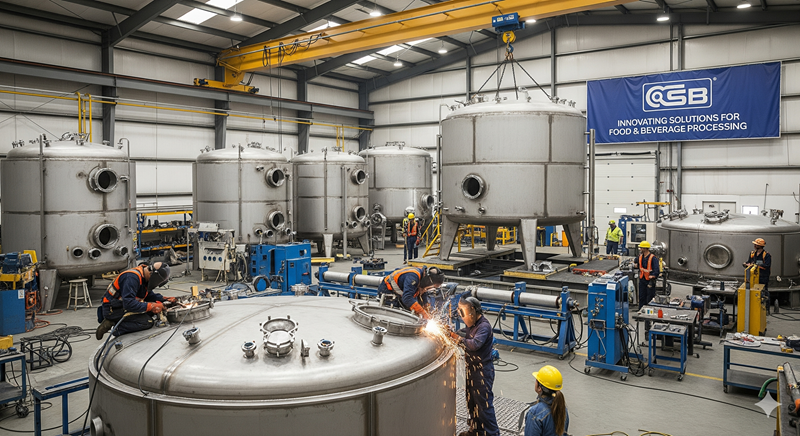
The Food & Beverage sector is an extremely dynamic and competitive industry that not only meets a basic nutritional need but also has to satisfy ever-increasing consumer expectations regarding issues like flavor, freshness, quality, and food safety. To meet these modern expectations, food engineering is becoming increasingly dependent on innovative technologies that extend shelf life, enhance product quality, and increase production efficiency. At the center of these technologies lies the strategic use of industrial and cryogenic gases (especially nitrogen and carbon dioxide). From freezing processes to packaging, from beverage carbonation to grinding operations, these gases are an indispensable part of today’s Food & Beverage industry. However, the effective and safe use of these gases depends on the systems where they are stored and transferred to the process, and all the accessories that make up these systems, meeting the highest hygiene and purity standards. At this point, companies like Cryotanx, which specialize in cryogenic storage, play a critical role by offering “food-grade” storage and distribution solutions to the Food & Beverage sector that guarantee food safety and product quality.
Preserving Freshness and Extending Shelf Life: Cryogenic Freezing and MAP Technologies
Two of the most fundamental goals of the modern Food & Beverage industry are to preserve the freshness of products as long as possible from the moment they are harvested or produced, and to reduce food waste by extending shelf life. Two main technologies using cryogenic gases stand out in achieving these goals: Cryogenic Freezing and Modified Atmosphere Packaging (MAP).
Cryogenic freezing is a rapid freezing process where extremely cold liquids, such as liquid nitrogen (-196°C) or liquid carbon dioxide (-78°C), are used to freeze food products in seconds or minutes. The greatest advantage of this technology over traditional mechanical freezing methods stems from its speed. When a food product is frozen slowly, the water molecules inside the cells combine to form large and sharp ice crystals. These large crystals rupture the cell walls, causing the product’s texture to deteriorate, release its water, and lose flavor when thawed. In cryogenic freezing, however, thanks to the extremely rapid cooling, countless “micro-crystals” form within the cells, without giving the water molecules a chance to combine. These small, rounded crystals do not damage the cell structure. As a result, a delicate fruit like a raspberry, a sensitive seafood item like shrimp, or a high-quality pastry almost completely retains its freshness, color, texture, and flavor when thawed. This process is usually carried out in special equipment such as “tunnel freezers” or “spiral freezers” through which a conveyor belt passes. These freezers are the main “accessory” of the process, and the continuous and intense flow of liquid nitrogen they require is supplied from a cryogenic storage tank manufactured by Cryotanx and installed at the facility site.
The other key technology in extending shelf life is Modified Atmosphere Packaging (MAP). In this method, the air inside a food product’s package (approximately 78% nitrogen, 21% oxygen, 1% other gases) is replaced with a gas mixture specially prepared according to the product’s characteristics. Oxygen is necessary for the growth of many microorganisms and for oxidative spoilage (e.g., fats turning rancid or meat turning brown). Removing oxygen from the package and replacing it with an inert gas like nitrogen dramatically slows down these spoilage processes. Sometimes, carbon dioxide is also added to the mixture because CO2 has an inhibitory effect on the growth of certain bacteria and molds. The shelf life of many products, such as freshly cut salads, red meat, nuts, and baked goods, can be extended for weeks thanks to this technology. The success of this process depends not only on the correct gas mixture but also on the purity and reliability of the system supplying this gas. A MAP line consists of a series of integrated accessories, such as a central storage unit like a micro-bulk tank supplied by Cryotanx, a gas mixer that blends the gases in the correct ratio, and the packaging machine that injects this mixture into the package. This is the guarantee of Food & Beverage quality.
Innovation and Quality in the Beverage Industry: Carbonation and Nitro Beverages
The beverage industry, one of the most dynamic sub-sectors of the Food & Beverage industry, uses industrial gases intensively both to maintain traditional quality and to respond to new consumer trends. The most classic and well-known application in this field is “carbonation,” which is the process of adding carbon dioxide (CO2) gas to beverages to give them that familiar refreshing “fizz” and “effervescence.” Soft drinks, sparkling waters, and many types of beer owe a significant part of their flavor profile to this process. In a large-scale beverage production facility, the high-purity CO2 required for the carbonation process is usually stored in liquid form in specially designed pressure vessels. These storage tanks are insulated and pressurized to keep the CO2 liquid at low temperatures. The liquid CO2 taken from the tank is passed through a vaporizer to convert it to the gas phase and is then fed to a special “accessory” called a “carbonator,” which dissolves the gas into the beverage under high pressure. This entire system—storage tank, vaporizer, pressure regulators, and carbonator—is the fundamental infrastructure that defines a beverage’s identity.
In recent years, a new trend has been rising in the Food & Beverage sector, especially in the coffee and beer segments: “nitro” beverages, i.e., beverages enriched with nitrogen. While carbon dioxide adds a sharp and acidic fizz to the beverage, nitrogen gas creates a much different effect. Because nitrogen is much less soluble in liquid and forms much smaller bubbles, it gives the beverage an extremely smooth, velvety, and creamy texture. That dense and persistent layer of foam on top of a “nitro cold brew” coffee or a “stout” beer is a result of this effect. To create this special texture, the beverage is pushed at high pressure through a specially designed tap with small holes (a stout tap) as it passes from the keg. This tap is one of the most critical accessories of the system. The nitrogen gas required for this process is supplied from high-pressure cylinders or portable DEWAR tanks in small-scale businesses, while a liquid nitrogen micro-bulk tank system installed by Cryotanx is used in larger-scale production.
Whether it’s CO2 for carbonation or nitrogen for nitro beverages, it should not be forgotten that the gases used in the Food & Beverage industry are “additives.” Therefore, it is an absolute necessity that the gases used and all equipment and accessories that come into contact with them meet “food-grade” or “beverage-grade” standards, meaning they contain no residues or contaminants harmful to human health.
Food & Beverage
Designing equipment and systems for the Food & Beverage industry differs from other industries on one fundamental point: the requirement of “hygienic design.” This means that equipment must not only perform its function but must also be easily cleanable, have a structure that does not allow bacterial growth, and be made of materials that are safe for food contact. This philosophy applies to all accessories, from the main storage tank to the smallest connection fitting.
The first rule of hygienic design is correct material selection. In the Food & Beverage sector, stainless steel grades such as 304L or 316L are most commonly used for surfaces that come into contact with food. These materials offer surfaces that are corrosion-resistant, smooth, and easy to clean. The second rule is surface smoothness. All weld seams must be ground and polished to be smooth, leaving no roughness or cracks where bacteria or food residues can accumulate. The third and most important rule is the absence of “dead spots” or “crevices.” In equipment design, any dead volume where liquids can pool and stagnate, cleaning agents cannot reach, and microorganisms can multiply, must be avoided. All valves, gaskets, sensors, and pipe connections must be selected according to these hygienic design principles. For example, “sanitary” type valves that are suitable for “Clean-in-Place” (CIP) processes and can be cleaned without disassembly, and hygienic connection fittings like “tri-clamp” are used. This forms the basis of a Food & Beverage facility’s overall food safety management system.
Cryotanx applies these hygienic design principles at the highest level in the solutions it offers specifically for the Food & Ceverage sector. A cryogenic storage tank or DEWAR tank produced by the company for this sector is not just a storage vessel, but a system fully compliant with food safety standards. Every “accessory,” from the inner surface of the tank to all pipelines and valves that contact the product, is selected from food-grade materials and assembled using hygienic manufacturing techniques. This gives the customer full assurance that their systems will successfully pass even the strictest food safety audits.
In conclusion, a fresh salad with a long shelf life that we buy from a supermarket shelf, a frozen fruit with its texture intact, or a creamy nitro coffee we drink at a café is actually the result of extremely sophisticated Food & Beverage technology and the equipment that makes this technology possible. The quality, freshness, and safety of the food we consume are increasingly based on these invisible but indispensable gas systems and the engineering knowledge and quality understanding of expert companies like Cryotanx behind them.


