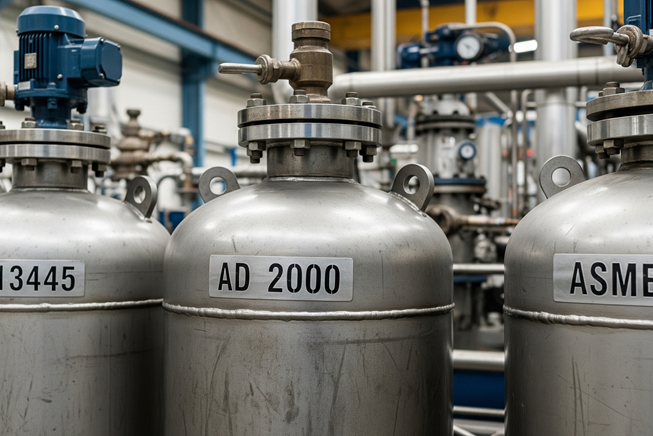
Comparison of Pressure Vessel Standards: ASME, EN 13445, and AD 2000 Codes
These three standards represent the most respected references for the design, manufacture, and inspection of pressure vessels in the global market. Their fundamental goal is the same: safety. However, the paths they follow, their philosophies, and their technical approaches to achieve this goal differ.
| Feature | ASME Code (Section VIII) | EN 13445 (European Standard) | AD 2000-Merkblatt (German Standard) |
| Origin and Geographical Prevalence | US origin. Very common in North America, the Middle East, and Asia. It is the de facto standard for the global oil and gas industry. | European Union (EU) standard. Designed and produced for the EU market. Complies with the PED (Pressure Equipment Directive). | German origin. A strong reference in high-engineering applications and especially in the German market. Complies with the PED. |
| Philosophy and Structure | A rule-based (prescriptive) “Code.” It describes what to do and how to do it step-by-step. The responsibility of the Manufacturer and the Authorized Inspector (AI) is essential. | A performance-based “Standard.” It offers a way to meet the “Essential Safety Requirements” of the EU’s legal PED. It is more flexible. | An extremely detailed and prescriptive technical standard. It reflects the German engineering tradition. It focuses on safety and quality and offers a path for PED compliance. |
| Design Approach | Generally based on allowable stress. The safety factor is based on the material’s tensile strength (~3.5 in Div. 1). This often leads to thicker-walled designs. | Based on yield strength. It uses lower safety factors (~1.5). This allows for material optimization, enabling lighter and more economical designs. | The design philosophy is similar to EN 13445, based on yield strength, but it can be more conservative in some calculations. |
| Material Requirements | Materials must be listed in ASME Section II. Using an unlisted material is difficult and requires special approval (Code Case). | Allows the use of materials compliant with European Material Approval (EMA) or harmonized EN standards. It has a more flexible structure. | Material requirements are very strict. Materials are specified in the “W” series documents and often require special manufacturer approval from organizations like VdTÜV. |
| Manufacturing and Inspection | Includes very detailed procedures for welding qualifications (Section IX) and non-destructive examination (NDE, Section V). The Authorized Inspector (AI) is directly involved in the process. | The inspection level varies according to the risk category. High-risk vessels require inspection by a Notified Body. Welding standards are ISO-referenced. | Contains extremely detailed and strict rules for manufacturing, welding, and testing processes. It is generally considered stricter than the base EN 13445 standard. |
| Certification and Marking | The manufacturer stamps the “U” Stamp on the vessel and issues a Manufacturer’s Data Report (MDR). | The manufacturer affixes the CE Marking to the vessel and issues a Declaration of Conformity. This is a legal requirement in the EU market. | CE Marking and a Declaration of Conformity are required. Additionally, certificates from inspecting bodies like TÜV are often present, which is an indicator of quality in the market. |
| Advantages and Distinguishing Features | – Global recognition and acceptance. – Comprehensive and proven structure. – Indispensable in the oil/gas industry. | – Material efficiency (lighter/cheaper vessels). – Modern and flexible design philosophy. – Mandatory for access to the EU market. | – High perception of quality and safety. – Extremely detailed and clear rules. – Preferred for critical and hazardous applications. |
Which Code Should Be Chosen?
The choice of the correct code depends on the project’s requirements and is generally determined by the following factors:
- Market and Geography: The country where the product will be sold or used is the most important factor. A product to be sold in the European Union must carry the CE Marking, which directs the manufacturer to harmonized standards like EN 13445 or AD 2000. For North America, the Middle East, or many Asian countries, the ASME “U” Stamp is often a contractual requirement.
- Customer Specification: The final decision is usually specified in the customer’s technical specification. In large industrial projects, which code to use is clearly defined.
- Design Optimization: If one of the primary goals of the project is to reduce weight or material cost, the design philosophy of EN 13445 may be more advantageous.
- Criticality of the Application: For applications involving very high-risk or hazardous chemicals, some customers may specifically demand the additional assurance and strict rules offered by AD 2000.
Details About Pressure Vessels Coded to EN 13445 / AD 2000 / ASME
Pressure vessels coded to EN 13445 / AD 2000 / ASME are sealed containers designed and manufactured according to high engineering and safety standards to hold a fluid (liquid or gas) under a specific pressure, forming one of the cornerstones of modern industry. The design, manufacturing, inspection, and certification of these tanks are strictly regulated by internationally accepted standards or “codes.” These codes are more than just technical guides; they are critical documents that ensure the safety of life and property, define legal obligations, and establish a common language in global trade. Pressure vessel manufacturing is an inherently high-risk process; therefore, there is no room for error in the design and manufacturing stages. Cryotanx, one of the leading companies in the sector, serves its customers at the highest safety and quality standards by deeply understanding all the requirements of these global codes. In this article, the differences, similarities, and application areas among the three major standards of the pressure vessel world—EN 13445, AD 2000, and the ASME Code—will be examined in detail.
The Historical Development and Industrial Importance of Pressure Vessel Standards
The industrial use of pressure vessels dates back to the 18th-century Industrial Revolution, specifically to the proliferation of steam engines. However, in these early periods, frequent boiler explosions occurred due to inadequate engineering calculations and material science, leading to significant loss of life and property. These tragic events gave rise to the need for standardization and regulation to ensure the safety of industrial production. In the early 20th century, the American Society of Mechanical Engineers (ASME), in response to this need, published the first “Boiler and Pressure Vessel Code.” This code revolutionized the industry by defining the minimum safety requirements, material specifications, manufacturing techniques, and testing procedures to be used in pressure tank design.
Over time, the ASME Code became one of the most recognized and applied standards on a global scale. In Europe, however, the situation developed somewhat differently. Germany, with its deep roots in engineering, developed its own standard, the AD Merkblatt series (later updated as AD 2000). This standard was known for its meticulous detail, strict safety factors, and comprehensive documentation requirements. With the formation of the European Union and the goal of a single market, the need arose to harmonize the different national standards of member countries. As a result of this need, the EN 13445 standard was developed by the European Committee for Standardization (CEN). EN 13445 adopted a more modern “Design by Analysis” (DBA) philosophy, offering innovative approaches to material efficiency and design flexibility. Today, these three main codes coexist in the global market, depending on the project’s geographical location, legal requirements, and customer demands.
Global players like Cryotanx stand out in international competition with engineering staff who have mastered the intricacies of all three codes, by determining the most suitable standard for the project or by executing a flawless manufacturing process according to the standard requested by the customer. The existence of these codes is not just a technical necessity but also an indicator of the manufacturer’s commitment to quality and reliability. Every step of a project, from the design phase to material selection, welding operations, non-destructive examinations, and the final hydrostatic test, must be meticulously managed within the framework set by these codes.
EN 13445 / AD 2000 / ASME Coded Pressure Vessels
EN 13445 / AD 2000 / ASME Coded Pressure Vessels represent three major standards that reflect different engineering philosophies and legal infrastructures, but all fundamentally serve the same purpose: that is, to guarantee safety, quality, and performance. The success of a project depends on which of these codes is chosen and how accurately its requirements are understood. The choice among these codes is shaped by many factors, such as the country where the tank will be used, the customer’s technical specification, legal requirements (for example, the Pressure Equipment Directive – PED for Europe), and even the economic goals of the project. Cryotanx provides consultancy to its customers in these complex decision-making processes, offering the most optimal solution for the project’s specific needs. Below, the technical specifications and philosophies of these three fundamental codes are examined in more detail.
The ASME Code (Section VIII): The Global Dominance of the American Standard
The ASME Code, especially with Section VIII, is the most widely used standard in the world in the field of pressure vessels. It has become a de facto industry standard, particularly in sectors such as oil and gas, petrochemicals, and power plants. The philosophy of the ASME Code is largely based on “Design by Rule” (DBR). In this approach, the code provides engineers with specific formulas, tables, and design rules. The engineer follows these rules to create a safe design. This method is a proven and conservative approach, reflecting an accumulation of experience over many years. ASME Section VIII is divided into three subsections:
Division 1: This is the most commonly used division. It applies to most pressure tanks within standard pressure and temperature ranges. The design formulas are relatively simple, and the safety factors are high (typically 3.5). This generally means thicker-walled and heavier tanks, but the design process is faster. Division 2 (Alternative Rules): It offers a more flexible and analytical approach for more demanding operating conditions. It allows for the use of a lower safety factor (typically 2.4), which makes it possible to design thinner-walled and lighter tanks. However, this requires a more detailed stress analysis and stricter manufacturing and inspection controls. This division also includes elements of “Design by Analysis“. Division 3 (High Pressure Vessels): It contains special rules for vessels that will operate at very high pressures (generally over 10,000 psi or 700 bar). In this division, much more advanced engineering calculations, such as fatigue analysis, are mandatory. A manufacturer producing in accordance with the ASME Code must be audited by an authorized inspection agency and obtain the certificate called the “U-Stamp“. This stamp is a global assurance that the tank was designed, manufactured, and tested in accordance with ASME standards.
EN 13445: Europe's Modern and Harmonized Standard
EN 13445 is the European Norm developed for “Unfired Pressure Vessels“. This standard, which is fully compliant with the European Union’s Pressure Equipment Directive (PED 2014/68/EU), is one of the fundamental references for obtaining the CE marking in the European market. The core philosophy of EN 13445, unlike ASME’s traditional approach, is its greater focus on “Design by Analysis” (DBA). This particularly encourages the use of modern calculation methods such as finite element analysis (FEA). In this way, the stresses on the tank can be calculated more precisely, and the material can be used more efficiently. This situation can often result in lighter and thus more economical products compared to an equivalent tank designed according to the ASME code. However, this flexibility requires more complex engineering calculations and greater expertise in the design process. The EN 13445 standard, unlike ASME which is a single large document, consists of many interrelated parts:
Part 1: General Part 2: Materials Part 3: Design (This is the most comprehensive part and includes formula-based and analysis-based design methods.) Part 4: Fabrication Part 5: Inspection and Testing EN 13445 also offers detailed and modern approaches to material selection, welding procedures, and non-destructive testing (NDT). It is considered to contain more comprehensive rules than ASME, especially regarding fatigue analysis and fracture mechanics. For many engineers, EN 13445 is a flexible and efficient standard that offers the opportunity to use modern engineering tools more effectively.
AD 2000 Merkblatt: The Meticulousness of the German Engineering Tradition
AD 2000 Merkblatt is the German pressure vessel standard and is considered a reflection of the German school of engineering: detailed, conservative, and extremely meticulous. Although it is compliant with the PED (Pressure Equipment Directive), it is still widely used even after the proliferation of EN 13445, especially in projects in Germany, Austria, and other countries that require this standard. AD 2000 is generally positioned somewhere between EN 13445 and ASME. Its design philosophy is rule-based like ASME but includes stricter safety factors and more detailed documentation requirements. A design made according to AD 2000 is generally heavier than a design made according to EN 13445, but can be similar to or slightly lighter than a design made according to ASME Div. 1. One of the most prominent features of this standard is the meticulousness of its material approval processes. Every material to be used may need to be approved by VdTÜV. Likewise, the manufacturing and testing processes are also very strictly inspected. Experienced manufacturers like Cryotanx are capable of managing the high level of documentation and traceability processes required by AD 2000. This means that every stage of the project is completely documented and audited, which provides the customer with additional assurance regarding the quality and reliability of the final product. In conclusion, the choice of which of these three codes to use is a strategic decision that requires an analysis of the project’s technical, legal, and commercial requirements.