


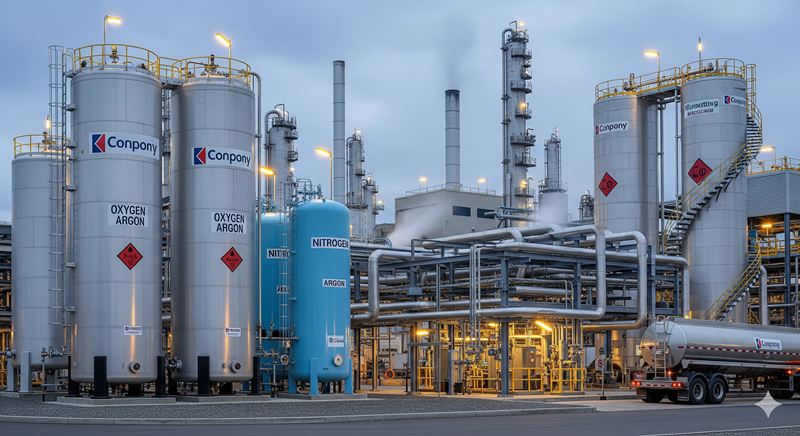
Industrial Gases are essential raw materials in gaseous or liquefied gas form, found naturally in the atmosphere or produced through chemical processes, playing vital roles in countless branches of industry, from welding processes to food preservation, and from metal production to medical applications. Gases such as nitrogen, oxygen, argon, carbon dioxide, and hydrogen, although usually invisible, are the fundamental driving forces behind the modern world’s production capability, technological advancement, and even quality of life. However, the real things that unlock and make the potential of these gases usable are not the gases themselves, but the specially designed systems and the critical “accessories” that make up these systems, which store, transport, and deliver them to the point of use under the desired conditions. In this context, companies like Cryotanx, which specialize in cryogenic and pressurized storage technologies, play a key role in every branch of industry by providing the fundamental infrastructure that turns the potential of industrial gases into reality, along with the most important accessories and components of this infrastructure.
Industrial Applications of Nitrogen, Oxygen, and Argon
Many of the most commonly used industrial gases in the industry are obtained from the air we breathe. Nitrogen, oxygen, and argon, known as “air gases,” are separated in cryogenic air separation plants by cooling the air down to -200°C to liquefy it, and then distilling it by taking advantage of the different boiling points of its components. These three gases undertake indispensable tasks in different areas of industry thanks to their different chemical properties.
Nitrogen (N2): Making up approximately 78% of our air, nitrogen has become the “Swiss army knife” of industry thanks to its most prominent feature: being “inert,” i.e., its tendency not to react chemically. In the Chemical and Petrochemical industry, it is the basis of the “inerting” process, which eliminates the risk of explosion by removing oxygen from tanks or reactors where flammable liquids are stored. In the Food & Beverage sector, it slows down oxidation and microbial growth by replacing the air inside food packages with nitrogen (MAP – Modified Atmosphere Packaging), extending the shelf life of products. In liquid form (LN2, -196°C), it is a cryogenic fluid that allows food to be frozen in seconds without compromising its quality. The continuous and reliable supply of nitrogen required for these various applications is usually provided through micro-bulk tanks installed on-site or smaller-scale DEWAR tanks, often supplied by Cryotanx. These storage tanks are an “accessory” as important as the nitrogen gas itself.
Oxygen (O2): Quite the opposite of nitrogen, oxygen’s greatest strength is its high reactivity. This property is used to accelerate combustion reactions and achieve higher temperatures. In steel production, pure oxygen is blown into giant furnaces to burn impurities like carbon in the iron. In the metal fabrication industry, it is used in oxy-acetylene or oxy-propane cutters for cutting thick steel plates. Furthermore, it is a fundamental element for life support in the medical & pharmaceutical sector and for water purification in water treatment plants. This high reactivity of oxygen necessitates that all equipment and accessories that come into contact with it be “cleaned for oxygen service” and made of special, non-flammable materials.
Argon (Ar): Heavier and even more inert than nitrogen, argon is a valuable gas used especially for high-quality welding processes. In processes like TIG and MIG welding, argon forms a shield around the weld pool, preventing the molten metal from reacting with oxygen and nitrogen in the air, which would create a weak and porous weld seam. This protective shield is critical for achieving flawless results in the welding of sensitive materials like stainless steel and aluminum.
Each of these basic air gases requires storage and distribution systems suitable for its own properties, and these systems are the most fundamental accessories that make the benefits of industrial gases available to the industry.
Energy and Reactivity: Managing Hydrogen, Carbon Dioxide, and Other Reactive Gases
Besides air gases, other industrial gases produced through chemical processes or obtained from natural sources also play vital roles in modern industry. These gases often stand out for being more reactive or requiring special storage conditions, and therefore, working with them requires special engineering solutions and equipment.
Hydrogen (H2): As both an energy carrier and an important chemical raw material, hydrogen is at the center of future clean energy and power generation. In the Oil and Gas industry, it is used in “hydro-cracking” processes where crude oil is converted into more valuable products. In the chemical industry, it is the basic input for ammonia and methanol production. However, storing hydrogen is difficult due to its low density. It is usually stored under very high pressures, such as 350 to 700 bar, in special high-pressure gas vessels resistant to these conditions. The material of these vessels must be resistant to the embrittlement that hydrogen can cause. Alternatively, it is stored in cryogenic storage tanks with the most advanced insulation systems, after being liquefied at an extremely low temperature of -253°C. Both methods fall within the competencies of companies like Cryotanx, which specialize in both high pressure and cryogenics.
Carbon Dioxide (CO2): A versatile molecule, carbon dioxide is used in the Food & Beverage industry to carbonate beverages. In welding, it creates a protective gas atmosphere in some applications. Its solid form, “dry ice,” is used in cold chain logistics and industrial cleaning (dry ice blasting). Liquid carbon dioxide is generally stored in specially insulated pressure vessels that withstand low temperatures and moderate pressures. These tanks and their associated cooling and pressurization accessories ensure that CO2 is stored safely.
Each of these reactive industrial gases, unlike standard air gases, requires its own specific safety protocols and material compatibility. It is vital for the system’s integrity that the material of a valve, a gasket, or a sensor does not react with the stored gas. Therefore, the storage systems and accessories used for these gases are often in the nature of a custom fabrication part.
Industrial Gases
Industrial Gases are delivered to the end-user through different supply modes, and the choice of the correct supply mode depends on the user’s consumption volume, purity needs, and operational requirements. Each link in this supply chain requires its own specific storage vessels and “accessories.”
For the lowest volume use, gases are generally supplied in steel cylinders under high pressures, such as 200 bar. For higher consumptions, “manifold” or “pallet” systems, where these cylinders are grouped, are used. After this point, storing gas in compressed form becomes inefficient, and liquefied gas supply begins. For medium-scale users, liquefied industrial gases are delivered in portable, vacuum-insulated DEWAR tanks. These tanks can meet the weekly needs of a laboratory, a welding workshop, or a clinic.
For industrial facilities with high-volume and continuous consumption, the most efficient solution is “bulk” supply. In this mode, cryogenic tanker trucks regularly bring liquefied gas to the facility and fill it into a fixed cryogenic storage tank (usually a micro-bulk tank or larger) manufactured by Cryotanx and installed at the facility site. This storage tank now becomes that facility’s own gas source. As can be seen, although the gas itself is the same, the storage and distribution system that makes it usable—that is, the most basic “accessory“—changes completely according to the user’s scale.
An industrial gases storage system is not just a tank. In a cryogenic system, there are vaporizers that convert the liquid gas into a gaseous phase before sending it to the point of use. Regulators that reduce the pressure to the desired level, safety valves that protect the system against overpressure, level gauges that show the amount of liquid in the tank, and specially insulated pipelines that connect all these components are integral parts of the system. This entire system can often be designed as a skid-mounted unit and delivered to the site with all accessories factory-installed and tested. This approach increases the system’s reliability and shortens the installation time.
In conclusion, industrial gases are the invisible but indispensable engines of modern industry. What brings their power and potential to the service of industry are the safe and efficient storage systems, designed and manufactured by expert companies like Cryotanx, optimized for the unique properties of each gas. Without these systems and every one of their critical “accessories,” industrial gases would remain just elements on the periodic table.


