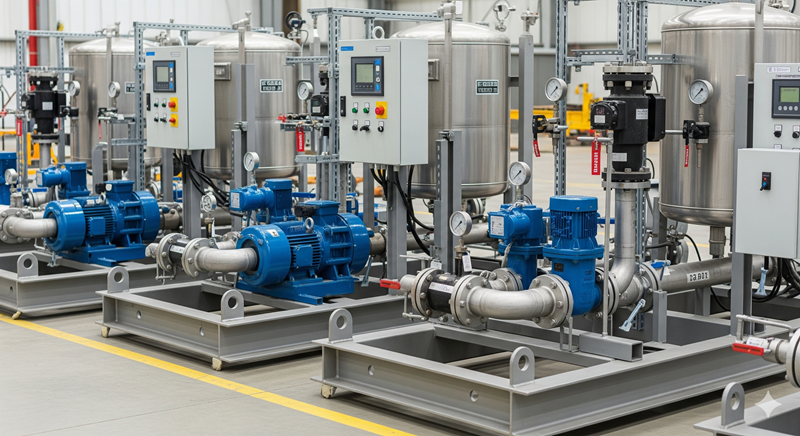
Skid-Mounted Units are a modern and extremely efficient engineering approach where complex industrial process systems—along with all their mechanical, piping, electrical, and instrumentation components—are integrated in the factory onto a single steel frame (skid), tested, and shipped to the site as a single module. Compared to the traditional “stick-built” method, these “plug-and-play” solutions shorten project timelines, enhance quality control, reduce costs, and minimize job site risks, becoming the standard in today’s competitive and fast-paced market. Firms with deep expertise in pressure vessels and cryogenic systems, like Cryotanx, adopt this modular approach to offer their customers not just a pressure vessel, but a complete special engineering solution built around that vessel. A skid-mounted unit transforms a project from being a sum of individual components into a holistic, tested, and optimized system.
Operational and Cost Advantages of Skid-Mounted Units
Skid-Mounted Units represent a fundamental paradigm shift in project management methodologies. In the traditional approach, a project’s progress largely consists of sequential and interdependent steps: first, site preparation and foundation construction are completed, then mechanical equipment is brought to the site and placed, followed by laborious and time-consuming processes like piping, electrical, and instrumentation installation. This linear process both extends the project timeline and harbors many uncertainties and risks.
Skid-Mounted Units, however, completely change this process thanks to the “parallel processing” principle. While the foundation construction and other preparations are ongoing at the customer’s site, the module—the heart of the process system—is simultaneously being built in the controlled factory environment of a manufacturer like Cryotanx. Having these two processes advance concurrently can save weeks, or even months, on the total project duration. This time saving is a critical financial advantage, meaning a facility can start production sooner and the return on investment can begin earlier.
Quality control is another overwhelming superiority of skid-mounted units. A construction site is open to many variables that can negatively affect quality, such as weather conditions, coordination difficulties between different subcontractors, temporary lighting, and constantly changing working conditions. A factory environment, conversely, offers ideal conditions: permanent and advanced welding machines, fixed lighting, climate control, a qualified and experienced workforce, and easier inspection opportunities. Welds made in this controlled environment are more flawless, pipe assemblies more precise, equipment alignments more perfect, and cabling more orderly. This high fabrication quality ensures the unit operates more reliably, for a longer lifespan, and with less maintenance.
This is a significant factor that reduces the Total Cost of Ownership (TCO). The cost advantages are not limited to just time and quality. The dramatic reduction in the number of man-hours spent on-site lowers site labor costs, which are often the largest cost item in projects. Furthermore, less on-site assembly means less material waste, a shorter need for crane rentals, and lower site management costs. When all these factors are combined, although the initial purchase cost of a skid-mounted unit may seem higher than buying the components individually, the “total installed cost” is almost always lower. Perhaps one of the most important advantages is risk reduction.
Skid-Mounted Units are subjected to a “Factory Acceptance Test” (FAT) before being shipped from the factory. During this test, the customer can personally see that all functions of their unit are working, pressure tests have been conducted, the automation system is responding as expected, and there are no leaks. This almost completely eliminates “bad surprises” that could occur on-site and reduces the commissioning process from a matter of days or weeks to a matter of hours.
Anatomy of a Skid-Mounted Unit
The design of a skid-mounted unit is a multidisciplinary engineering symphony. This process involves much more than just placing existing equipment on a steel frame; it is the art of creating an optimized and compact system where every part will work in harmony with each other, with humans, and with environmental conditions. At the heart of this philosophy lie 3D modeling and detailed engineering calculations. The first step of the process is the design of the chassis, the skid itself. This steel structure must be able to carry the static and dynamic loads of the tons of equipment on it, withstand the vibrations and stresses during transport, and have certified lifting lugs to be lifted safely.
Cryotanx‘s engineering team virtually creates this entire system in advanced 3D CAD software. This digital modeling prevents the “clash detection” of pipes, valves, and instruments, ensures ergonomic access to critical equipment for maintenance and operation (e.g., safety valves or filters), and allows the entire system to be fitted into the smallest space most efficiently. At the heart of the system is one or more pressure vessels, often one of the EN 13445 / AD 2000 / ASME coded vessels. This could be an air tank, a process reactor, a filter vessel, or a cryogenic storage tank. Around this main equipment, all other components required by the process are integrated: pumps, compressors, heat exchangers, vaporizers, and valves. The pipelines connecting all this equipment require special attention. The piping must be designed according to standards appropriate for the fluid’s pressure and temperature (e.g., ASME B31.3), include flexibility loops (expansion loops) or compensators to handle thermal expansion and vibration, and be properly supported. Welds made in the factory environment are of much higher quality compared to those made on-site.
Modern skid-mounted units are also automation marvels. Instruments such as pressure, temperature, flow, and level sensors are placed precisely, and all their wiring is routed neatly in cable trays to a central junction box or a control panel located on the side of the unit. This allows the unit arriving at the site to be connected to the facility’s main control system (DCS/PLC) with just a single power cable and a single communication cable. This “plug-and-play” approach eliminates complex wiring and instrument calibration work that could take weeks on-site. Cryotanx manages all these mechanical, piping, and automation disciplines under one roof, delivering a fully thought-out, integrated, and fully certified skid-mounted unit to the customer.
Skid-Mounted Units
Skid-Mounted Units, thanks to their modular and flexible structure, can be adapted to almost any industrial process imaginable. The beauty of these systems is that they can be “tailor-made” to the specific needs of each project, rather than being a standard solution. This makes them ideal, especially for niche and technology-intensive applications. In the energy sector, “Fuel Gas Conditioning Skids,” which filter, heat, and precisely regulate the pressure of natural gas going to a gas turbine, are commonly used. These skid-mounted units are the guarantee for the safe and efficient operation of multi-million dollar turbines. Similarly, LNG tanks or L-CNG (Liquid-to-Compressed Natural Gas) stations often consist of a series of modular skid units. One skid might contain cryogenic pumps and piping, another might house ambient air vaporizers, and a third might contain the pressure reduction and measurement system.
This modular approach allows a complex facility to be manufactured in more manageable parts and assembled on-site like building blocks. In the chemical industry, “Dosing Skids,” used to inject chemicals into processes at precise rates, play a critical role. Used in many fields from water treatment plants to oil refineries, these skid-mounted units include one or more tanks, dosing pumps, mixers, and control instruments. Full factory testing ensures these units will perform the correct dosing from the very first startup on-site. The rising hydrogen economy is also opening new horizons for skid-mounted units. The pressurization, cooling, and dispensing equipment of a hydrogen refueling station is often designed as a compact and safe skid unit. This approach allows for the rapid deployment of next-generation fuel infrastructure.
Cryotanx‘s special engineering solutions philosophy comes into play at this exact point. The firm works as a solution partner from the moment a customer arrives with a process flow diagram (P&ID). The engineering team converts this diagram into a 3D model, selects the most suitable equipment, performs all structural and fluid dynamics calculations, and presents it for the customer’s approval. The approved design is brought to life in the fabrication workshop according to the highest quality standards. Continuous communication with the customer is maintained throughout this process.
Logistics and site installation are the final acts of this meticulous process. The completed and tested skid-mounted unit is packaged suitable for sea or road transport. When it arrives at the site, one of the most satisfying moments of the project timeline occurs: the unit is placed onto the pre-prepared foundation in a single crane operation. All that remains is to make a few main pipe and cable connections (“hook-ups”). A complex assembly process that could have taken months is thus condensed into a few days. This is the greatest value skid-mounted units offer to modern industry: managing complexity, shortening time, and bringing projects to success.