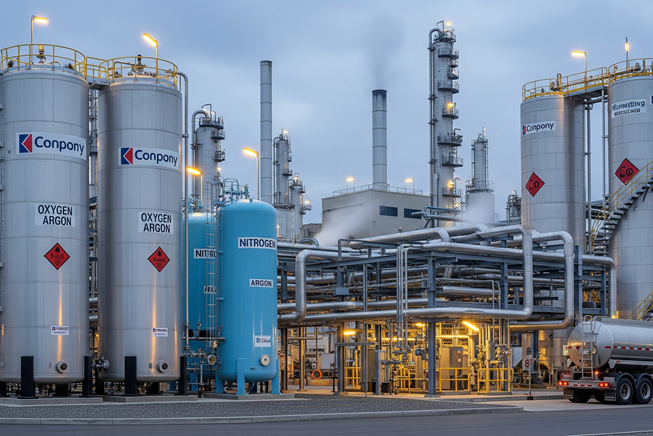
Accessories and Components are not just parts of industrial systems like pressure tanks, cryogenic storage tanks, gas storage systems, pressure vessels, vaporizers, heat exchangers, and atmospheric storage tanks; they are the heart and brain of these systems. The safety, efficiency, lifespan, and operational success of a facility are directly related to correctly selected, high-quality, and mutually compatible accessories and components. These elements cover a wide spectrum, from a simple bolt to the most complex control valve, and each one plays a critical role in the integrity of the process. As a leading engineering and manufacturing firm in its field, Cryotanx specializes in the supply and integration of these critical elements that form the backbone of industrial facilities, offering solutions that observe this delicate balance at the highest level. Therefore, every investment made in accessories and components is, in fact, a direct investment in the facility itself.

The Cornerstone of Industrial Storage Systems: Safety Equipment and Control Mechanisms
Pressure vessels and gas storage tanks used in industrial processes are, by their nature, equipment with high-risk potential. Exceeding the design and operating pressures of these systems can trigger events that could lead to catastrophic consequences. For this reason, safety equipment and control mechanisms are a facility’s insurance policy and first line of defense. Accessories and components in this category ensure that the system can safely relieve itself in the event of a potential overpressure situation or allow for intervention by notifying the operator of abnormal conditions. The most fundamental accessories in this field are safety relief valves and rupture discs. Safety relief valves are mechanical devices that automatically open when the system pressure reaches a preset value, releasing the excess fluid (gas or liquid) in a controlled manner.
They are divided into two main types: spring-loaded and pilot-operated. Spring-loaded models are widely used due to their simple and reliable structure, while pilot-operated valves stand out with their more precise opening-closing tolerances and ability to operate in higher pressure ranges. The correct selection and sizing of a safety relief valve must be meticulously carried out according to the system’s maximum discharge capacity, in compliance with international standards such as ASME (American Society of Mechanical Engineers) and API (American Petroleum Institute). Cryotanx engineers offer the safest solution by considering not only normal operating conditions but also external scenarios like fire when performing these calculations.
Rupture discs, on the other hand, are single-use components made from materials like metal or graphite, which provide full opening by bursting at a specific pressure. They are particularly preferred in situations where very rapid pressure increases are expected or where the fluid could clog a safety valve, such as in polymerization. Often, a rupture disc is installed in series at the inlet of a safety relief valve. This configuration both ensures the valve is protected from corrosive fluid and guarantees zero leakage. In addition to these basic relief devices, control accessories and components like pressure regulators, pressure switches, and pressure transmitters also ensure the system remains within a safe operating range.
Regulators maintain the pressure of the fluid going to the tank or line at a constant value, while switches and transmitters measure the instantaneous pressure value and transmit this information to the control room or to automatic shutdown systems (ESD – Emergency Shutdown System). The harmony between these components is the key to the safe and efficient operation of the process.
Specialized Accessories and Components for Cryogenic and Gas Storage
Cryogenic storage tanks and systems are special equipment that operate at temperatures below -150°C, such as liquefied nitrogen (LIN), oxygen (LOX), argon (LAR), or natural gas (LNG). This extreme cold presents serious material and design challenges for standard accessories and components. At low temperatures, standard carbon steels become brittle and fracture-prone. Therefore, all accessories and components used in cryogenic applications must be manufactured from materials that can maintain their low-temperature toughness, such as austenitic stainless steel (304/316 series), bronze, or special aluminum alloys.
The most critical accessories in this field are undoubtedly cryogenic valves. Cryogenic valves, unlike standard valves, have an “extended bonnet” design. This design keeps the valve packing away from the cold fluid, preventing it from freezing and losing its sealing property. Otherwise, moisture from the atmosphere freezing in the packing area would impede the valve’s operation, creating both operational and safety risks. Globe valves, ball valves, and butterfly valves are manufactured with this special bonnet structure for cryogenic services. Another vital group of components is the vacuum jacketed piping (VJP) and perlite/vacuum insulation systems used to minimize heat transfer between the inner and outer tanks.
These systems prevent the loss of cryogenic liquid through evaporation (boil-off) and stop the tank’s pressure from rising undesirably. Cryogenic storage tanks designed by Cryotanx offer long-term and safe storage capabilities thanks to these high-efficiency insulation systems.
Special components like the pressure build-up vaporizer are also used for the tank’s operational continuity. This unit takes a small amount of liquid from the tank, vaporizes it, and sends it back to the tank’s gas phase, thus balancing the tank pressure that drops during product withdrawal. Level gauges are designed using special transmitters that operate on the differential pressure (DP) principle and are resistant to these harsh conditions. All these specialized accessories and components form an integrated ecosystem that ensures a cryogenic system not only operates, but does so safely and economically.
Advanced Measurement Instrumentation for Process Efficiency and Safety
In modern industrial facilities, the principle “you can’t control what you can’t measure” applies. In all systems, from atmospheric storage tanks to the most complex pressure vessels, the instantaneous and accurate monitoring of process variables is indispensable for both safety and efficiency. The accessories and components that provide this monitoring are generally referred to as instrumentation and include level, pressure, temperature, and flow measurement devices. Level measurement is critical for knowing the amount of product inside the tank, managing inventory, and preventing overflows. The technologies used for this are selected based on the fluid’s physical and chemical properties, the tank’s geometry, and the operating conditions. Magnetic level gauges are simple and reliable components that work on the float principle. Ultrasonic level transmitters send sound waves and measure their reflection, while radar level transmitters use microwaves to offer high accuracy even in more challenging conditions (foam, vapor, variable density).
One of the most common methods, especially for closed and pressure tanks, is differential pressure (DP) measurement. The pressure difference taken from the bottom and top of the tank is proportional to the hydrostatic height of the liquid, and thus, level information is obtained. Pressure measurement is used to monitor whether the system remains within operational limits. A wide range of accessories is available, from a simple manometer (pressure gauge) to smart pressure transmitters that provide standard signal outputs like 4-20 mA.
Temperature measurement is vital, especially in processes where temperature is a critical parameter, such as in cryogenic storage tanks or heat exchangers. Resistance temperature detectors (RTD, like Pt100) and thermocouples are the most frequently used sensors for this purpose. These sensors are usually placed inside a protective sheath called a “thermowell” to protect them from the corrosive or abrasive effects of the fluid. Expert firms like Cryotanx operate with the awareness that the correct instrument selection forms the foundation of a facility’s automation infrastructure, and they enable process control with reliable and repeatable data by determining the most suitable technology for each measurement point.
Structural Integrity and Operational Continuity: Supportive and Auxiliary Systems
The performance of a storage tank or pressure vessel depends not only on the main body that holds the fluid inside but also on the auxiliary accessories and components that support, protect, and operationally complete it. This category includes structural elements, insulation systems, and auxiliary units like vaporizers, which are often overlooked at first glance but are essential for the system’s long-term and trouble-free operation.
Structural supports are components that safely transfer the weight of the tank, the weight of the product inside it, and external loads such as wind, snow, and seismic activity to the ground. “Saddle” type supports are used for horizontal tanks, while “leg” or “skirt” type supports are used for vertical tanks. The design and welding of these supports are just as important for the tank’s integrity as the tank itself and require engineering calculations. Insulation plays a critical role, especially in equipment where temperature control is important, such as cryogenic storage tanks and heat exchangers.
The combination of perlite powder and vacuum used in cryogenic tanks minimizes heat ingress, while materials like rock wool and glass wool used in hot lines or boilers prevent heat loss. Incorrect application or damage to insulation can lead to serious and hard-to-detect problems like “Corrosion Under Insulation” (CUI). Therefore, the cladding system that protects the insulation material from external elements is as important a component as the insulation material itself. Vaporizers are vital accessories, especially for systems where liquefied gases are stored.
Ambient air vaporizers have an aluminum finned design and convert the cryogenic liquid (e.g., liquid nitrogen) into a gas phase using the heat from the ambient air, without needing any external energy. This is an extremely efficient and economical method for meeting the continuous gas demand in industrial processes. Other small accessories and components, such as manhole covers, sight glasses, grounding lugs, and lifting lugs, also make the tank’s maintenance, operation, and installation processes safe and practical. Cryotanx provides its customers with turnkey, fully integrated, and operationally excellent solutions by addressing all these auxiliary systems as a whole, along with the main equipment.