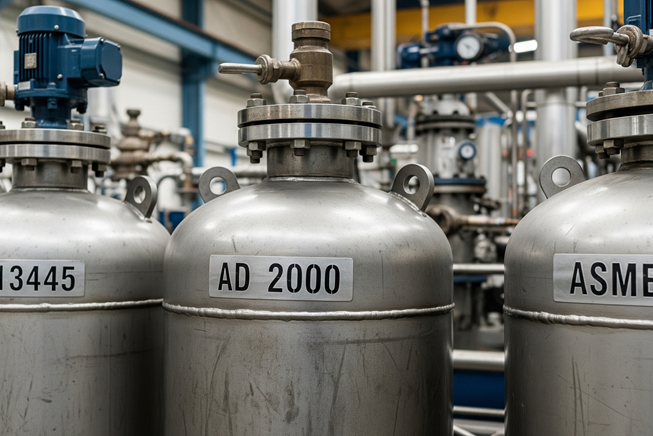
The design and fabrication of pressure vessels are processes too critical to be left to discretion. Globally accepted standards and regulations exist that all stakeholders operating in this field must adhere to. These standards create a common language for engineers, manufacturers, and inspectors, ensuring the safety, reliability, and compatibility of equipment across different countries. Compliance with these codes is not just an engineering preference, but also a legal obligation and a commercial necessity. Insurance companies and local authorities require compliance with these standards for facilities to obtain operating licenses. Two main players stand out in this global arena of standards: the US-origin ASME BPVC and the European Union’s legal framework, PED.
However, other national and regional standards such as JIS in Japan, CSA in Canada, and PD 5500 in the UK also play an important role in their respective geographies.
ASME Boiler and Pressure Vessel Code (BPVC)
The Boiler and Pressure Vessel Code (BPVC), published by the American Society of Mechanical Engineers (ASME), is the most widely recognized and used standard worldwide. First published in 1914, this massive document has continuously evolved, reaching 28 volumes and over 16,000 pages as of 2011. The Code is updated with a new edition every three years, along with annual addenda published between editions, in parallel with technological developments and field feedback.
The most relevant section for pressure vessels is “Section VIII: Rules for Construction of Pressure Vessels.” This section is divided into three subsections:
- Division 1 (Div. 1): The most commonly used division worldwide. It generally applies to vessels operating at pressures below 3,000 psi (207 bar). The design philosophy is known as “design-by-rule.” In this approach, the code describes step-by-step how the design should be done by providing the manufacturer with specific formulas and tables. Vessels successfully completed under this division carry the “U,” “UM,” or “UV” ASME stamps.
- Division 2 (Div. 2 – Alternative Rules): Presents a more complex and analytical approach. It adopts the philosophy of “design-by-analysis” and generally requires the use of advanced engineering tools such as Finite Element Analysis (FEA). This division allows for higher stress values, which can lead to more efficient (thinner-walled and lighter) designs. However, this flexibility is balanced by requiring more detailed calculations, stricter material controls, and more comprehensive Nondestructive Examination (NDE) requirements. Vessels under this section receive the “U2” and “UV” stamps.
- Division 3 (Div. 3 – Alternative Rules for High-Pressure Vessels): A highly specialized division designed for vessels operating at very high pressures above 10,000 psi (690 bar). These vessels carry the “U3” and “UV3” stamps.
The strength of the ASME code comes from the integration of its sections. For instance, Section VIII directly refers to Section II (Materials) for material properties, Section V (Nondestructive Examination) for NDE procedures, and Section IX (Welding and Brazing Qualifications) for the qualification of welding procedures and welders. This holistic structure ensures consistency and quality at every stage of the process. The key figure in this process is the “Authorized Inspector” (AI), authorized by the National Board. The AI is an independent third party who monitors the fabrication process, verifies the manufacturer’s quality control system compliance with ASME requirements, witnesses critical tests (e.g., hydrostatic test), and finally signs the manufacturer’s data report, allowing the vessel to receive the code stamp.
European Pressure Equipment Directive (PED 2014/68/EU)
The Pressure Equipment Directive (PED), a legal requirement for pressure vessels placed on the market in the European Economic Area (EEA), takes a philosophically different approach from the ASME code. PED is not a detailed design code, but a legal directive that defines the “Essential Safety Requirements” (ESRs). This directive covers all pressure equipment with a pressure greater than 0.5 bar and classifies this equipment into categories from Category I to Category IV based on the risk they carry (depending on factors such as the hazard class of the fluid contained, pressure, and volume). As the risk category increases, the conformity assessment procedures that the manufacturer must follow also become stricter.
To demonstrate that a product complies with PED, the manufacturer affixes the “CE mark” to the product. This mark serves as a “passport” for the product to circulate freely in the European market and indicates that the manufacturer declares the product’s conformity with all relevant EU directives.
PED, instead of detailing “how” the design should be done, specifies “what” needs to be achieved (i.e., the Essential Safety Requirements). Manufacturers typically use “harmonized standards” to demonstrate that they meet these requirements. Compliance with these standards provides a “presumption of conformity” that the PED’s essential requirements have been met. The most important harmonized standard for pressure vessels is EN 13445 (Unfired Pressure Vessels). Other important standards include EN 12952 (Water tube boilers) and EN 12953 (Shell boilers). The conformity assessment of high-risk equipment is carried out by “Notified Bodies” appointed by member states. These organizations are the European counterparts of the Authorized Inspectors in the ASME system.
This fundamental philosophical difference between ASME’s prescriptive approach and PED’s performance-based approach has significant implications for global manufacturers. ASME specifies in detail how to build a safe vessel, while PED defines what a safe vessel must achieve and leaves the “how” question more flexible. This requires a global player like Cryotanx to be fluent in both “languages.” The engineering and quality departments must have a dual-track capability to design and certify both ASME-stamped products for the North American market and CE-marked products for the European market. This dual compliance capability is a key competitive advantage and a demonstration of engineering excellence that distinguishes a routine manufacturer from a global leader.
| Division |
Design Pressure |
Design Philosophy |
Key Features |
ASME Stamp |
| Division 1 |
Generally < 3000 psi (207 bar) |
Design-by-Rule |
Most commonly used, standard-formula-based, more conservative design approach. |
U, UM, UV |
| Division 2 |
Generally < 10,000 psi (690 bar) |
Design-by-Analysis |
Allows higher stress limits, requires more detailed analysis (FEA) and NDT. Lighter and more efficient designs are possible. |
U2, UV |
| Division 3 |
> 10,000 psi (690 bar) |
Design-by-Analysis |
Highly specialized rules for very high-pressure applications. Requires fracture mechanics analysis. |
U3, UV3 |
|
|
|
|
|