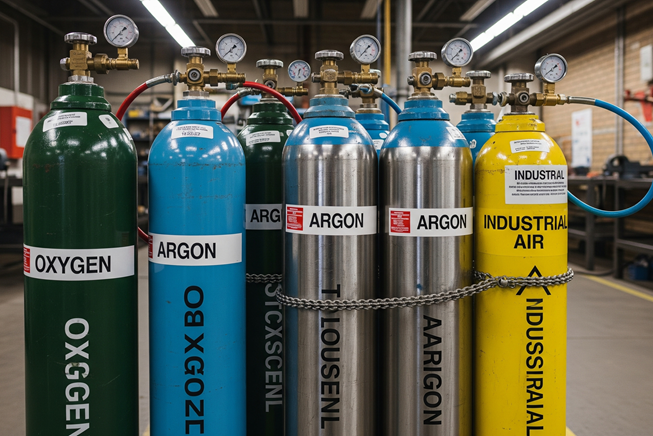
Table of International Standards for Air Tanks
General Safety and Maintenance Rules
Regardless of the standard they were manufactured to, the following rules apply to all air tanks:
- Periodic Inspection: Tanks must be subjected to controls such as physical examination and hydrostatic testing by authorized persons at intervals specified by local legal regulations (generally once a year in Turkey).
- Safety Valve: There must be a working safety valve on the tank, set to the maximum working pressure. This valve prevents the tank from exploding in case of overpressure.
- Water Draining (Blowdown): Moisture in the compressed air condenses and collects as water at the bottom of the tank. This water causes corrosion (rusting), weakening the tank wall. Therefore, the water must be drained regularly using the drain valve at the bottom of the tank.
- Corrosion Control: Both the internal and external surfaces of the tank should be regularly checked for corrosion. Areas with peeling paint or rust should be repaired immediately.
- Nameplate: The tank must have a metal label (nameplate) containing information such as the manufacturer’s name, production year, serial number, maximum working pressure, temperature, and volume, and this label must be legible.
Details About Air Tanks
Air Tanks are indispensable components of compressed air systems in industrial and commercial facilities, and are critical pressure vessels that have a direct impact on the overall efficiency, safety, and stability of the system. Usually working in conjunction with a compressor, these tanks do much more than just store compressed air; they meet instantaneous high demand, save energy by reducing the load on the compressor, dampen pressure fluctuations, and help cool the air to separate moisture within it. Expert companies like Cryotanx, which reflect their deep engineering experience in cryogenic gas storage onto the manufacturing of all types of pressure vessels, offer reliable and long-lasting solutions to the industry’s needs with high-quality air tanks produced in accordance with the strictest international codes such as EN 13445 and ASME. The performance of a compressed air system is largely determined by a correctly designed and positioned air tank, and this investment provides operational improvements for businesses that quickly pay for themselves.
Critical Functions of Air Tanks and Their Effect on Efficiency
If we were to compare a compressed air system to the human body, where the compressor is the lungs, then air tanks are undoubtedly the heart of the system. This analogy perfectly summarizes the central and vital role of the tank within the system. Air tanks are far beyond being simple storage units; they are multi-functional engineering components that ensure the healthy, efficient, and stable operation of the system. Foremost among these functions is optimizing the compressor’s operating cycles to provide energy efficiency and extend equipment life. Piston or screw compressors are designed to operate within a specific pressure range. When the system pressure drops to the lower limit, the compressor starts working (loads), and when it reaches the upper limit, it stops or idles (unloads). If the system lacks an adequately sized air tank, even the smallest air usage causes the pressure to drop rapidly, forcing the compressor to cycle on and off very frequently.
This frequent “load/unload” cycling leads to significant wear and tear on the compressor motor and mechanical components, and also causes immense energy waste due to the high current draw at each start-up. A correctly sized air tank dramatically reduces the frequency of these cycles. The tank acts as a large air reservoir, meeting small and medium air demands without starting the compressor. The compressor only kicks in when the pressure in the tank drops significantly, runs for a longer duration to efficiently fill the tank, and then rests for a longer period. This optimization provides significant savings directly observable on the facility’s electricity bill while also reducing the compressor’s maintenance costs and likelihood of failure. Another critical function of air tanks is meeting instantaneous high air demands (peak demand). Some industrial applications, such as sandblasting, paint spraying, or pneumatic presses, require very high volumes of compressed air for short durations. Choosing an oversized compressor capacity just to meet this instantaneous demand would be an inefficient solution, increasing both the initial investment cost and ongoing operational expenses. Instead, the air tanks in the system act like a kind of “energy battery.” The large amount of air stored in the tank instantly meets these peak demands, preventing the system pressure from collapsing.
This makes it possible to operate with a smaller, more efficient compressor sized for the facility’s average consumption. Furthermore, air tanks dampen pressure fluctuations, ensuring that air is delivered to the point of use at a constant and stable pressure. This is vital, especially for applications using sensitive pneumatic control equipment or where the final product quality, such as paint finish, depends on air pressure. Lastly, these tanks perform an important secondary task crucial for system health: cooling the air and separating moisture. The air compressed in the compressor heats up and contains a high amount of water vapor. When this hot, moist air enters the larger volume and cooler surface of the tank, it cools rapidly. Cooling causes the water vapor in the air to condense into liquid form. This liquid water collects at the bottom of the tank and is discharged from the system via the drain valve at the tank’s bottom. This simple physical process alleviates the load on dedicated equipment like air dryers and helps prevent damage caused by rust and corrosion in compressed air lines, pneumatic tools, and end products. Thanks to these versatile benefits, air tanks are an integral part of every modern compressed air system.
Design, Material and Safety Standards in Air Tanks
Although air tanks may look like simple steel cylinders from the outside, they are engineering structures that store a significant amount of potential energy and are therefore subject to extremely strict rules for their design, manufacturing, and inspection. The safety and longevity of an air tank are ensured by the correct material selection, full compliance with internationally accepted design codes, and the critical safety accessories integrated onto it. In this field, the experience of companies like Cryotanx, which manufacture pressure vessels for much more demanding conditions such as cryogenic storage tanks, is also reflected in the production of standard air tanks, significantly increasing the quality and reliability level of the resulting products. International design and manufacturing codes form the foundation of the manufacturing process. In Europe, the EN 13445 standard, and in America and many countries around the world, the ASME Boiler and Pressure Vessel Code, Section VIII (ASME Section VIII) are the most competent authorities in this area. These codes define every step in minute detail, from the calculation methods to be used in the design of an air tank, material properties, qualification of welding procedures, to the post-production nondestructive examination (radiographic, ultrasonic testing, etc.) and hydrostatic pressure tests required.
An air tank bearing the CE mark or ASME stamp certifies that it has successfully passed all these rigorous processes and meets international safety standards. Cryotanx conducts all its pressure vessel manufacturing within the framework of these global standards, offering its customers the highest level of assurance. Material selection is also a critical factor for the tank’s lifespan and performance. Standard air tanks are generally manufactured from carbon steels specifically produced for pressure vessels, such as P265GH or SA-516 Gr.70. The biggest enemy of this material is internal corrosion caused by moisture accumulating inside the tank. To slow down this corrosion, the internal and external surfaces of the tanks are coated with special paints. However, especially in sectors where the compressed air must be extremely clean, such as food, pharmaceutical, electronics, or sensitive painting applications, the mixing of rust particles into the system is unacceptable. For such situations, air tanks with an internal surface coated with hot-dip galvanizing or made entirely of stainless steel are preferred.
Stainless steel air tanks offer complete resistance to corrosion, guaranteeing the purest air quality. Safety is the most important element in the design of an air tank, and this safety is provided by the accessories mounted on it. The most vital of these is the safety valve. In the event that the system pressure rises to dangerous levels, for reasons such as the failure of the compressor’s pressure switch, the safety valve automatically opens to discharge the excess air, preventing the tank from exploding. Another is the pressure gauge, which allows the pressure inside the tank to be read instantaneously. The drain valve located at the very bottom is critical for regularly draining the water that accumulates inside the tank and causes corrosion. These drain valves can be manual, or they can be automatic types with timers or level sensors. Finally, owning an air tank also brings the responsibility of periodic maintenance and inspection. Periodic checks, such as ultrasonic measurement of the tank’s wall thickness and inspection of its general condition by authorized institutions, ensure that the tank continues to serve safely.
Correct Air Tank Selection and Optimization
Selecting the right air tank for a compressed air system directly affects the overall efficiency of the system and the return on investment. Tank selection is not just about randomly determining a volume; it is an optimization process that requires careful analysis of a range of factors, such as the compressor type and capacity, the facility’s air consumption profile, and physical layout possibilities. Making the right decisions in this process provides the business with significant long-term cost advantages and operational reliability. The first and most fundamental decision is determining the tank’s volume. There are various rules of thumb commonly used in the industry for this. For example, multiplying the compressor’s free air delivery (in CFM or l/s) by a certain coefficient is a frequently used method.
However, these simple rules may not always yield the most accurate result. For a more precise selection, the compressor type should be considered. Piston compressors, due to their nature, produce a pulsating air flow and thus require larger air tanks. Screw compressors, providing a more continuous flow, can operate with relatively smaller tanks. The facility’s air consumption profile is also a critical variable. A facility with constant and predictable air consumption throughout the day will have different tank requirements than a facility experiencing frequent sudden and high peaks during the day. A system with high peak demands needs a larger storage volume, meaning a larger air tank, to meet these demands. The ideal tank size should be calculated to keep the compressor’s load/unload cycles per hour within the manufacturer’s recommended optimal range (usually 6-10 cycles/hour).
Choosing an undersized air tank leads to frequent compressor starts and energy waste, while an oversized air tank brings both a higher initial investment cost and takes up unnecessary space within the facility. Another important decision is the tank’s orientation: vertical or horizontal? Vertical air tanks are a popular choice, especially in facilities with limited space, as they require a smaller footprint. The vertical design also allows for more efficient draining of accumulated water at the bottom of the tank via gravity. Horizontal air tanks, on the other hand, have a lower profile and are sometimes used to create a compact, packaged system by being mounted on a single skid along with other equipment like the compressor and dryer. They can also be advantageous in areas where ceiling height is limited for maintenance or access.
The physical conditions and layout plan of the facility should be carefully evaluated when making this choice. In conclusion, selecting the right air tank requires balancing a range of technical parameters and operational needs. At this point, working with a manufacturer possessing deep engineering knowledge, like Cryotanx, makes a significant difference. Within the scope of its offered special engineering solutions, Cryotanx not only provides a standard product but also analyzes the customer’s existing system and needs to design the air tank solution with the most suitable volume, orientation, material, and accessory configuration. This expert approach guarantees that the installed system operates with maximum efficiency, safety, and longevity.