International Standards and Regulations
The safety of high-pressure vessels is strictly regulated by the following international standards:
Details About High Pressure Gas Containers
High-Pressure Gas Vessels are pressure vessels that are extremely critical and require advanced engineering, designed to store gases under pressure far above atmospheric pressure in many fields of industry and modern technology. Due to the immense potential energy they contain, the design, fabrication, and inspection of these vessels are controlled by extremely strict international standards and regulations, leaving no room for even the smallest error. These systems, which safely store a wide range of fluids from energy carriers like hydrogen and natural gas to industrial process gases like nitrogen, argon, and oxygen, form the basic infrastructure of the energy, chemical, manufacturing, and health sectors. In this high-risk and technology-intensive field, companies with proven expertise in cryogenic tanks, such as Cryotanx, are able to respond to even the most demanding requirements of the industry by reflecting their mastery of the most challenging codes like EN 13445 / AD 2000 / ASME onto the production of high-quality and reliable High-Pressure Gas Vessels. The performance of a high-pressure gas vessel is measured not only by its capacity to hold gas, but also by its ability to do so with absolute safety and integrity for decades.
Materials Science and Mechanical Integrity in High-Pressure Gas Vessels
The design process of High-Pressure Gas Vessels is a complex engineering discipline that lies at the intersection of fundamental physics laws and advanced material science. The pressure inside these vessels exerts an immense force on the vessel’s walls in all directions. The designer’s primary task is to create a structure that can safely withstand this force throughout its intended operational life. The starting point of this process is stress analysis. In a cylindrical vessel, two main types of stress occur due to internal pressure: “hoop stress,” which encircles the vessel like a ring, and “longitudinal stress,” which acts along the long axis of the vessel. According to basic mechanical principles, the hoop stress is approximately twice the longitudinal stress. Therefore, the wall thickness of a high-pressure gas vessel is calculated primarily to withstand this higher hoop stress. Design codes such as ASME Section VIII or EN 13445 provide the precise formulations, including variables like the vessel’s diameter, design pressure, material properties, and weld efficiency, necessary for engineers to perform these calculations. These calculations are the first and most fundamental guarantee of the tank’s mechanical integrity.
However, the correct formula alone is not enough; the material used in the formula also determines the project’s fate. The material selected for High-Pressure Gas Vessels must possess not only high tensile and yield strength but also high “fracture toughness.” Fracture toughness is a measure of how well the material can resist the growth of microscopic flaws or cracks that may exist in its structure, without leading to a catastrophic failure. For this purpose, high-strength carbon steels like SA-516 Gr.70 or special alloy steels such as chrome-molybdenum (Cr-Mo) are used to counter risks like “hydrogen embrittlement” that can be caused by specific gases like hydrogen.
It is an indispensable part of the quality assurance process that every selected material comes with material test certificates (MTC) documenting its chemical and mechanical properties. The fabrication stage, especially welding engineering, is another critical phase that determines the quality of high-pressure gas vessels. It is essential that the welds are as strong and flawless as the base material. Therefore, all welding operations are performed according to pre-tested and approved welding procedure specifications (WPS/PQR) and only by certified welders. The welding process can leave undesirable stresses in the metal’s structure. To eliminate these “residual stresses” and increase the material’s toughness, many completed high-pressure gas vessels are subjected to a controlled heating and cooling process called “Post-Weld Heat Treatment” (PWHT). The competence of manufacturers like Cryotanx in these complex fabrication processes forms the foundation of the reliability of the high-pressure gas vessels they produce.
Risk Management in High Pressure Gas Containers
The amount of energy stored inside High-Pressure Gas Vessels can be equivalent to a small bomb. Therefore, the safety philosophy regarding these vessels is not based on “fault tolerance,” but on the “zero defect” principle. The practical reflection of this philosophy is international codes, strict quality control procedures, and mandatory tests. Producing a safe high-pressure gas vessel is not a choice, but a legal and ethical obligation. The backbone of this process is formed by international standards like ASME, EN 13445, and AD 2000 Merkblatt. These standards are an accumulation of industrial experiences, scientific research, and unfortunately, lessons learned from tragic accidents over more than a century. The design, fabrication, and certification of a high-pressure gas vessel according to one of these codes is a statement that the vessel was produced using the best known engineering practices and provides the highest level of protection against potential risks. One of the most important tools of the quality control process is “Nondestructive Testing” (NDT) methods. These methods are used to detect potential defects inside or on the surface of the vessel without causing physical damage.
Especially weld seams, as they can be the weakest link of a high-pressure gas vessel, are intensively inspected. Radiographic Testing (RT) is similar to taking an X-ray of the weld seam and reveals volumetric defects inside such as porosity, slag, or cracks. Ultrasonic Testing (UT) can detect even the smallest cracks inside the material using high-frequency sound waves. Methods like Magnetic Particle Testing (MT) and Liquid Penetrant Testing (PT) are used to make cracks visible that are on the surface or very close to the surface.
Cryotanx meticulously applies these tests on every high-pressure gas vessel it produces, according to the project’s requirements and the mandatory requirements of the codes. After the fabrication and inspection processes are completed, every high-pressure gas vessel is subjected to a final verification test called a “hydrostatic test.” In this test, the vessel is completely filled with water and then slowly pressurized, usually to 1.3 to 1.5 times the maximum allowable working pressure. There is a critical safety reason for conducting the test with water: Water, unlike gases, is almost incompressible. Therefore, if there is a leak or weakness during the test, the pressure drops instantly, and the event is limited to a small water leak.
If the test were conducted with air or another gas, in the event of a failure, the vessel would explode like a bomb, leading to a devastating result. A vessel that successfully passes the hydrostatic test is proven to be able to safely withstand its design pressure. Finally, operational safety is ensured by protective equipment mounted on the tank, such as safety valves or rupture disks. These devices, in the event of an unexpected pressure increase in the system, act as the last line of defense, safely discharging the excess gas and preventing a disaster. This multi-layered safety approach makes it possible for high-pressure gas vessels to be used safely in the industry.
High Pressure Gas Containers
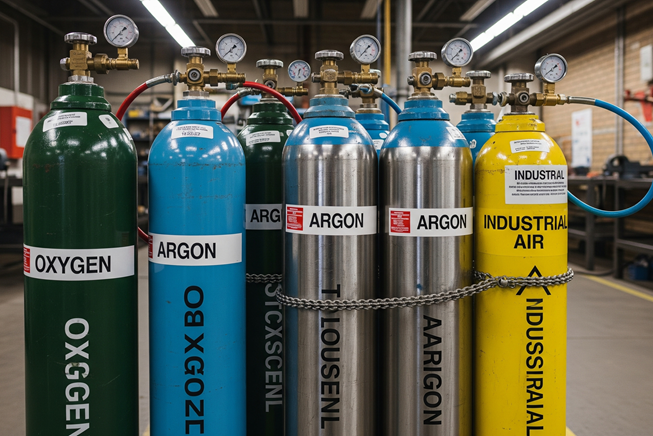
High-Pressure Gas Vessels play a critical role in almost every corner of modern industry, serving different purposes. The application areas of these vessels show a wide variety, depending on the type of gas stored and its intended use. This diversity often requires not only standard designs but also application-specific special engineering solutions and tanks. One of the most common areas of use is the storage and distribution of industrial gases. Gases such as nitrogen, oxygen, and argon produced in air separation plants are stored under high pressure in massive high-pressure gas vessels and from there are filled into smaller cylinders or tankers to be delivered to end-users. In the chemical and petrochemical industries, these vessels are used not only for storage but also as reactors for chemical reactions that take place under high pressure. These reactors are at the heart of many chemical processes, from polymer production to fertilizer synthesis.
The energy sector is another important and rapidly growing market for high-pressure gas vessels. Compressed Natural Gas (CNG) is emerging as a cleaner alternative to diesel fuel, especially for public transport vehicles and truck fleets. At CNG filling stations, natural gas from the pipeline is compressed by compressors and stored in a series of interconnected high-pressure gas vessels called a “cascade.” This storage system allows vehicle tanks to be filled quickly. Hydrogen, seen as the energy carrier of the future, is also most efficiently stored under high pressure. Hydrogen storage needs at hydrogen refueling stations and industrial facilities typically require special high-pressure gas vessels operating at very high pressures, such as 350 to 700 bar.
Due to hydrogen’s potential to embrittle some metals (hydrogen embrittlement), these tanks must be made from special alloy steels or composite materials with a coated inner surface. This is one of the most challenging and innovative areas of high-pressure gas vessels technology. Cryotanx is ready to play an important role in developing and producing these critical infrastructure components required for the future hydrogen economy, with its deep engineering background.
With the advancement of technology, high-pressure gas vessels made of composite materials are replacing traditional steel vessels, especially in mobile applications where weight is critical. These vessels, which include a polymer liner reinforced with carbon fiber or glass fiber, can be up to 70% lighter than their steel counterparts. This makes them indispensable, especially for hydrogen-powered cars, buses, and, in the future, airplanes. In conclusion, each application has its own unique pressure, temperature, gas compatibility, and cycle life requirements. It is rare for a standard product to fit every situation. Therefore, a flexible and capable manufacturer like Cryotanx creates real added value by analyzing the customer’s specific needs and designing and manufacturing high-pressure gas vessels that include the most appropriate material, design, and safety features.